
Hard Water Stains on Clothes: Why California Laundry Comes Out Wrong — and How to Fix It
White residue on dark clothes, gray cast on whites, stiff towels after washing, musty-smelling “clean” laundry — these are hard water problems, not detergent problems. Here is exactly what California’s water is doing to your laundry and how to stop it.
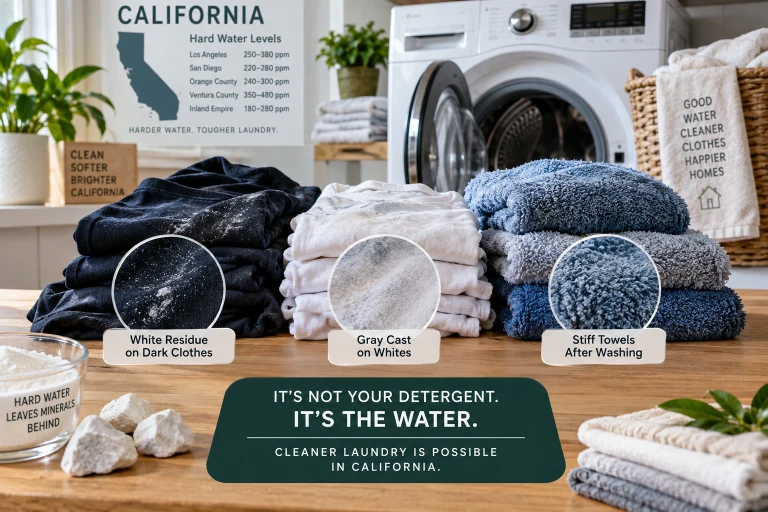
Southern California homeowners notice it most after moving from a soft-water city: clothes don’t feel as clean, whites develop a gray cast, dark clothes show white or gray streaks after washing, and towels that were soft become progressively stiffer with each wash. The problem is almost always California’s hard water — and the solution is not buying more detergent.
At 200–479 ppm, Southern California’s tap water carries significantly more dissolved calcium and magnesium than the national average of 110–130 ppm that most detergent dosage recommendations, washing machine settings, and laundry guides are calibrated for. Those minerals interact with detergent, fabric fibers, and your washing machine in predictable ways — all of which make your laundry worse, not better.
This guide explains exactly what’s happening, how to remove existing hard water stains from clothes, and the laundry adjustments that prevent the problem going forward.
What Hard Water Actually Does to Your Laundry
It Makes Your Detergent Less Effective
Laundry detergent works by suspending dirt and oil particles in water so they rinse away from fabric. The surfactant molecules in detergent are specifically designed to bind to both water and non-water substances simultaneously. In soft water, they do this efficiently. In hard water, calcium and magnesium ions in the water bind to the surfactant molecules first — before those molecules can bind to dirt. The result: soap scum. The calcium-surfactant compound precipitates out of solution as an insoluble sticky residue that deposits on fabric fibers rather than on dirt. You are literally washing your clothes in your own detergent residue.
The practical effect: you need significantly more detergent per load to achieve the same cleaning result in hard water as in soft water. At 278 ppm (Mission Viejo range), detergent efficiency drops measurably compared to national average water. At 479 ppm (Ventura), the efficiency loss is substantial. This is why California homeowners in hard water cities often find themselves using more detergent than the cup markings suggest — and still getting suboptimal results.
It Leaves Mineral Deposits on Fabric
In addition to making detergent less effective, hard water leaves dissolved calcium and magnesium deposits directly on fabric fibers. These deposits are colorless initially but become visible as:
- White or grayish streaks on dark clothing: Calcium carbonate deposits are white. On dark fabrics (black jeans, navy towels), they show clearly as streaks or patches that appear after the clothes are worn or viewed in good light.
- Gray cast on whites: The same mineral deposits create a dulling layer on white fabrics that prevents them from appearing genuinely white. The fabric isn’t dirty — it’s coated in a thin mineral layer.
- Stiffness and roughness: Mineral deposits embedded in fabric fibers create stiffness. Towels that feel like cardboard after washing are almost always the result of calcium and magnesium deposits in the terry loops. This is not a fabric softener deficiency — it’s a mineral deposit.
It Traps Odors
Calcium-surfactant compounds deposited in fabric fibers trap bacteria, dead skin cells, and organic material that would otherwise rinse away in soft water. This organic material becomes a food source for bacteria, which produce the musty or sour odor that “clean” laundry sometimes carries in California hard water cities. The laundry smells musty not because it wasn’t washed long enough, but because it was washed in water that left behind residue that supports bacterial growth.
The simplest test: dampen the residue and rub it between your fingers. If it feels slippery or soapy — it’s undissolved detergent or soap scum from detergent-mineral interaction. Switch to less detergent (or HE formulation) and run an extra rinse cycle. If it feels gritty or slightly granular and doesn’t feel soapy — it’s mineral deposit from hard water. Add a cup of white vinegar to the rinse cycle (vinegar is mildly acidic and dissolves calcium carbonate deposits) and see if the residue reduces on subsequent washes. In California hard water, it’s very often both: the soap scum from detergent-mineral interaction and direct mineral deposits acting simultaneously.
Over time, yes. Mineral deposits embedded in fabric fibers create abrasion between fibers during wear and washing, gradually weakening the fiber structure. Towels and T-shirts washed repeatedly in hard water without mitigation measures become thinner and weaker faster than identical items washed in soft water. The practical effect: you’ll need to replace towels, sheets, and everyday fabrics sooner in a hard-water household than in a soft-water one if no mineral mitigation is in place. The mineral deposits also interfere with fabric dye molecules, causing colors to fade faster in California hard water than the fabric manufacturer’s expected care cycle predicts.
How to Remove Existing Hard Water Stains from Clothes
White Vinegar Soak Method (Most Common)
White vinegar is a mild acid (5% acetic acid) that dissolves calcium carbonate — the primary mineral in hard water deposits. It’s safe for most fabrics (avoid extended use on silk and very delicate materials) and is inexpensive.
Prepare a vinegar soak
Fill a basin or sink with warm water and add one cup of white vinegar per gallon of water. Submerge the stained garment and let it soak for 30–60 minutes. The acidity breaks down calcium carbonate deposits on the fabric surface. For heavily stained items, extend the soak to 2 hours.
Gently agitate and rinse
After soaking, gently rub the formerly stained areas between your fingers to help dislodge any loosened mineral deposits. Rinse thoroughly with clean water to remove both the vinegar and the dissolved minerals. Do not wring tightly — gentle squeezing preserves fiber integrity.
Wash normally with correct detergent
Wash in the machine as normal after the soak, using HE detergent at the correct amount for your California water hardness. If you’re in Zone 3–4 (200+ ppm), add half a cup of white vinegar to the fabric softener dispenser compartment during the wash cycle. The vinegar acts as a natural water softener in the rinse cycle, helping to prevent re-deposition of minerals on the fabric.
Citric Acid Treatment (Stronger, for Heavier Deposits)
Citric acid is a more potent mineral dissolver than vinegar. Dissolve 1–2 tablespoons of food-grade citric acid powder in a basin of warm water. Soak for 30–45 minutes. Rinse thoroughly. Citric acid is more aggressive and should be used on items with stubborn mineral buildup that vinegar alone didn’t resolve — particularly heavily stiffened towels and linens. It’s safe for cotton and synthetic fabrics; test on a hidden area before treating natural fibers like silk or wool.
Laundry Stripping for Severely Buildup-Heavy Items
Laundry stripping is a deep cleaning technique for towels, sheets, and workout clothes that have accumulated years of mineral and detergent residue. Fill a bathtub or large bucket with the hottest water your fabric type tolerates (check care labels). Add a combination of borax (quarter cup), washing soda (quarter cup), and a small amount of powdered detergent (or a laundry stripping product). Submerge items and let soak for 4–6 hours, stirring every hour. The water will turn dark gray-brown as mineral deposits and organic residue leave the fabric. Wring out and wash normally. This is a deep reset for severely buildup-heavy items — not a regular laundry practice.
What stripping water color tells you: Dark water (gray-brown) indicates heavy mineral and organic buildup — common in California hard water households where no mineral mitigation has been in place. Lighter water indicates recent mineral accumulation or less buildup. If the strip water is nearly clear, the items were not as heavily deposited as expected — or have been regularly maintained.
Adjusting Your Laundry Routine for California Hard Water
Use the Right Detergent in the Right Amount
Switch to HE formulation: If you have a front-loader and are using standard detergent, switch to HE (High Efficiency) detergent immediately. Standard detergent creates excess suds in a front-loader’s low-water environment, compounding the soap scum problem that hard water already creates.
Adjust dosage for your water zone: Detergent cap markings are calibrated for national average water (roughly 110–130 ppm). In California hard water:
- Zone 1 soft (50–120 ppm): Use 20–30% LESS than the recommended dose. Soft water activates surfactants more efficiently, so the same amount cleans more thoroughly with less product. Overdosing in soft water creates excess suds and the residue that causes mold.
- Zone 2 moderate (121–200 ppm): Use the recommended dose.
- Zone 3 hard (201–300 ppm): Use up to 20% more than recommended, or add a tablespoon of laundry borax to boost detergent effectiveness by conditioning the hard water.
- Zone 4 very hard (300+ ppm): Increase dose by 20–30% or use a hard water-specific detergent formulation. Adding half a cup of laundry borax per load is the most cost-effective way to improve cleaning results at this hardness level.
Add Vinegar to the Rinse Cycle
Adding half a cup of white vinegar to the fabric softener dispenser compartment is one of the most effective and inexpensive interventions for California hard water laundry. The vinegar is released during the rinse cycle, where its mild acidity neutralizes any remaining mineral deposits on the fabric before they dry. Clothes come out softer (the mineral-stiffening effect is reduced), whites stay brighter, and dark clothes show significantly less white streaking. The vinegar smell dissipates entirely during the rinse and subsequent drying — your laundry will not smell like vinegar.
Note: Do not add vinegar to the main wash compartment where it will interact with and neutralize your detergent. Always add vinegar to the fabric softener compartment for rinse-cycle release.
Run an Extra Rinse Cycle
In Zone 3–4 California cities, a single rinse cycle often leaves residual minerals from the wash water on fabric. Selecting an extra rinse cycle (or the Extended Rinse option on many Samsung and LG models) gives the fabric an additional clean-water pass to remove mineral residue before drying. This is most relevant for heavily soiled loads and for large items (towels, sheets) where complete rinse penetration takes more water volume.
Laundry Water Conditioners and Borax
Laundry borax (sodium borate): Borax softens water by binding to calcium and magnesium ions before they can interact with detergent molecules. Adding half a cup of borax per load in Zone 3–4 cities effectively reduces the mineral interference with detergent and improves cleaning results without a whole-house water softener. Borax is available at most supermarkets (20 Mule Team Borax is the widely available product) and is inexpensive at roughly $0.15–$0.20 per load addition.
Washing soda (sodium carbonate): Washing soda is a water conditioner that also reduces hard water mineral content in the wash cycle. More aggressive than borax — use with care on delicate fabrics. Most effective when added with detergent in the main wash compartment.
Commercial hard water laundry additives: Products like Calgon Water Softener (which is actually a water conditioner) and similar products work by sequestering calcium and magnesium ions in solution so they can’t precipitate onto fabric or interfere with detergent. Most effective in Zone 3–4 cities. Follow package dosage.
Temperature and Cycle Selection
Mineral precipitation from hard water is accelerated by heat — a hot wash cycle deposits more calcium carbonate on fabric than a cold one. This creates a trade-off: hot water cleans better (particularly for oils, body soil, and bacteria), but in hard water it deposits more minerals on fabric. The practical recommendation:
- Everyday clothes and dark items: cold wash to minimize mineral deposition and color fading
- Towels, sheets, and heavily soiled items: warm (not hot) wash, with vinegar in the rinse cycle to mitigate mineral re-deposition
- Whites that need brightening: the monthly hot cleaning cycle (without laundry) descales the machine; for the white laundry itself, warm wash with OxiClean or oxygen bleach booster performs better than hot wash in hard water because it avoids excessive mineral deposition while improving cleaning through oxygen action
The Hard Water Stain on Clothes vs. the Hard Water Problem in the Machine
The mineral deposits that appear on your clothes are the same mineral deposits that accumulate inside your washing machine’s pump filter, inlet screens, and door boot seal. The source is identical: California’s hard water. The difference is that the internal machine accumulation eventually causes mechanical failures — drain errors, fill errors, seal degradation, bearing failure — while the fabric accumulation causes laundry quality problems.
The two problems compound each other: a partially blocked pump filter from scale accumulation means the machine drains more slowly, which means water sits in contact with fabric longer, which means more mineral deposition on the fabric before the final spin cycle. A descaled machine with a clean filter and clear pump housing drains efficiently, reducing the contact time between hard wash water and fabric and producing better laundry results alongside better mechanical reliability.
This is why machine maintenance and laundry quality in California hard water are linked: maintaining the machine on the right schedule for your city’s water improves both laundry outcomes and mechanical longevity simultaneously. See our California hard water machine guide and complete maintenance schedule.
| Hard Water Laundry Problem | Cause | Solution |
|---|---|---|
| White streaks on dark clothes | Calcium carbonate deposits on fabric fibers | Vinegar soak + rinse cycle vinegar addition; reduce detergent dose |
| Gray cast on whites | Mineral dulling layer on white fibers | OxiClean oxygen booster + vinegar rinse; occasional citric acid soak |
| Stiff towels | Calcium deposits in terry fiber loops | Monthly vinegar soak (or laundry stripping for severe cases); ongoing rinse-cycle vinegar |
| Musty smell after washing | Soap scum residue trapping bacteria in fibers | Reduce detergent dose; extra rinse; vinegar rinse; monthly machine cleaning |
| Colors fading faster than expected | Mineral deposits abrading dye molecules | Cold wash for darks; vinegar rinse cycle; consider water conditioner |
| Laundry feels “not clean” | Soap scum from detergent-mineral interaction reducing cleaning effectiveness | Increase detergent dose (Zone 3–4) or add borax; HE detergent only for front-loaders |
Hard water problems in your laundry often mean scale problems in your machine
If you’re seeing heavy mineral deposits on clothes, your pump filter and inlet screens almost certainly need descaling too. A professional maintenance visit addresses both the machine condition and confirms your maintenance interval for your city’s water hardness.
Should You Get a Water Softener? The California Cost-Benefit
A point-of-entry ion exchange water softener — installed at the main water line — reduces household water hardness to near zero for every faucet and appliance in the home. In Zone 3–4 California cities (200–479 ppm), the financial case is increasingly compelling:
- Laundry improvement: Immediate. Clothes clean better with less detergent, stiffness eliminated, colors preserved longer.
- Appliance protection: Extends life of washing machine, dishwasher, water heater, and coffee maker simultaneously.
- Plumbing protection: Prevents scale accumulation in pipes and fixtures over time.
- Cost: Point-of-entry water softeners run $1,000–$3,000 installed, plus $100–$200/year in salt for the ion exchange regeneration process.
- Payback period: In Zone 4 cities at 350–479 ppm, the combination of detergent savings, appliance maintenance savings, and extended appliance lifespan often produces payback within 5–8 years.
If a whole-house softener isn’t feasible (common in rental properties or condo buildings where main-line access is unavailable), the combination of rinse-cycle vinegar, laundry borax per load, HE detergent at correct dose, and quarterly machine maintenance provides significant mitigation of hard water’s laundry impact without infrastructure investment.
FAQ — Hard Water Stains on Clothes
Fabric softener addresses stiffness by coating fiber surfaces with lubricating agents, but it doesn’t remove or prevent the mineral deposits that cause the stiffness in hard water. Fabric softener also adds a waxy residue to fabric that, over time, reduces absorbency (particularly in towels) and traps the soap scum and mineral residue that hard water already creates. The cycle becomes: hard water deposits minerals, fabric softener adds waxy coating over deposits, next wash deposits more minerals on the waxy surface. Vinegar in the rinse cycle is more effective for hard water stiffness because it dissolves the mineral deposits rather than covering them. If you prefer fabric softener, use it in addition to vinegar (not simultaneously — in separate cycles), but vinegar alone is the better intervention for hard water specifically.
Yes, in most cases. Calcium carbonate (the primary component of hard water mineral deposits) is soluble in mild acid. A vinegar soak followed by a normal wash with vinegar in the rinse cycle removes visible white streaks and patches from dark clothing in the large majority of cases. Stubborn deposits may require a citric acid soak (more concentrated acid) or a second treatment. Deposits that have been present for very long periods and have become significantly embedded in fiber may be harder to fully remove — the treatment will improve but may not fully eliminate them. Going forward, rinse-cycle vinegar addition prevents new deposit formation and prevents the current situation from recurring.
Comparably hard in terms of ppm, but the specific mineral profile of California water — particularly Colorado River water — can differ in its behavior from hard water in other US regions. Colorado River water carries elevated levels of specific minerals including sulfates that can contribute to fabric discoloration differently from calcium-dominated hard water. The interaction with laundry detergent formulations that are calibrated for East Coast and Midwest water chemistry can produce different residue characteristics. For practical purposes, the ppm comparison is the most useful indicator of how much mitigation is needed.
Cold water reduces mineral precipitation compared to hot water (heat accelerates the precipitation of dissolved minerals from solution), so cold wash cycles do produce somewhat less mineral deposition per wash than hot cycles. However, cold water doesn’t eliminate the mineral content from the water — it just slows the rate of deposition. At Zone 3–4 California hardness levels, mineral deposits on fabric will still accumulate with cold washing over time, just more slowly. The vinegar rinse cycle addition is effective regardless of wash temperature and is the most practical mitigation for both cold and warm wash cycles.
Leave a Comment
Questions about hard water stains on your clothes or laundry results?