
The Complete California Washer Maintenance Schedule: Every Task, Every Interval, Calibrated to Your City’s Water
Generic washer maintenance guides ignore California’s most important variable: water hardness. A maintenance schedule written for 110 ppm national average water is wrong for Ventura at 479 ppm and unnecessary for Sacramento at 60 ppm. Here is the complete schedule calibrated to where you actually live.
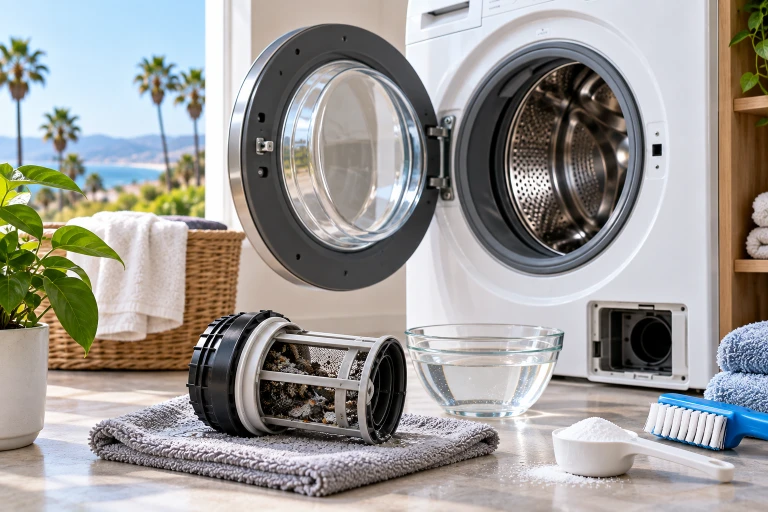
Most California homeowners who eventually have a washer break down at year 4 or 5 had a machine that was maintained on a schedule written for someone else’s water. The quarterly pump filter cleaning recommended for California hard water cities is missing from generic national guides. The biannual door seal inspection that prevents the leading cause of drum bearing failure in Southern California isn’t in the manual. The coastal mold prevention protocol specific to Pacific-adjacent neighborhoods isn’t anywhere in the manufacturer documentation.
This guide gives you the complete schedule — every task, every interval — with specific adjustments for California’s water hardness zones and the maintenance differences between front-loaders and top-loaders. Save it, print it, set calendar reminders. The $20–$30/year in DIY maintenance materials this schedule requires prevents $400–$1,200 in service calls that are entirely avoidable with the right habits.
Step 1: Find Your California Water Hardness Zone
Everything in this schedule varies based on your city’s water hardness. Find your zone before reading the specific intervals.
| Zone | Hardness | Representative Cities | Water Source |
|---|---|---|---|
| Zone 1 — Soft | 50–120 ppm | Sacramento, Elk Grove, Lincoln, Roseville, SF, Oakland, Berkeley, Richmond, Sunnyvale, Santa Cruz | Sierra Nevada snowmelt (SFPUC, PCWA, EBMUD, SCVWD) |
| Zone 2 — Moderate | 121–200 ppm | Antioch, Fontana, Rancho Cucamonga, Moreno Valley, Palmdale (lower range) | Delta/groundwater blends, Chino Basin, WMWD |
| Zone 3 — Hard | 201–300 ppm | San Diego County, most OC cities, LA Metro, Burbank, Palmdale, Redondo Beach, Newport Beach, La Jolla | SDCWA, MWDOC, Mesa Water, West Basin MWD (Colorado River blends) |
| Zone 4 — Very Hard | 300+ ppm | Ventura, Thousand Oaks, Simi Valley, Glendale, Santa Clarita, Laguna Beach, Encinitas, Mission Viejo | Calleguas MWD, local groundwater + Colorado River blends |
Source: Municipal Consumer Confidence Reports (CCRs). Exact hardness varies by source blend and season. Your utility’s annual CCR (available online) gives precise current readings. Full California hardness city list →
Search “[your city or water district] Consumer Confidence Report 2024” or “[your utility] water quality report.” Hardness is listed as calcium carbonate (mg/L or ppm) or in grains per gallon (GPG; multiply GPG by 17.1 to get ppm). Alternatively, water hardness test strips ($8–$15 for 50 strips) from any hardware store give a same-day ppm reading accurate to ±10%.
For the water-hardness tasks (pump filter, inlet screens, descaling cycles): the same interval applies to all machines in your home since they all receive the same water. For the mold-prevention tasks (door seal care, door-ajar habit): front-loaders require this and top-loaders don’t. A house with one front-loader and one top-loader applies the full schedule to the front-loader and only the non-mold maintenance tasks to the top-loader.
After Every Load — 2 Minutes, Non-Negotiable
| Task | Front-Load | Top-Load | Why It Matters |
|---|---|---|---|
| Remove laundry promptly | ✓ Essential | ✓ Essential | Clothes left in drum transfer mold spores; damp laundry in a sealed drum accelerates mold growth. |
| Leave door/lid ajar | ✓ Essential — minimum 2 hrs (3–4 hrs in coastal CA) | ✓ Leave lid open when not in use | The single most impactful mold prevention habit. Sealed humid drum = mold growth in 1–2 weeks. |
| Wipe lower door seal fold dry | ✓ Strongly recommended | N/A | Removes the pooled water in the lower seal fold that is the primary mold substrate. Takes 20 seconds. |
| Wipe drum door gasket dry | ✓ Yes, if any visible moisture | N/A | Particularly important in Zone 4 hard water where mineral deposits embed in rubber faster when wet is left on the surface. |
Monthly Maintenance — 20–30 Minutes
Drum Cleaning Cycle (All Washer Types)
Run an empty wash cycle at the hottest available temperature (Tub Clean, Sanitize, or highest temperature setting) with a cleaning agent. Options:
- Affresh tablet: Dissolves slowly over the full cycle, effective on HE detergent residue and biofilm. Best for Zone 1–2 soft to moderate water.
- Citric acid descaling tablet: Also dissolves scale deposits in addition to biofilm. Better for Zone 3–4 hard water cities where mineral accumulation is the dominant concern.
- 2 cups white vinegar directly in the drum: Effective, inexpensive, works for all water zones. Never combine vinegar with a cleaning tablet in the same cycle — run one or the other.
Never run a bleach cycle and a vinegar cycle consecutively without a plain water rinse cycle in between.
Dispenser Drawer Cleaning (Front-Loaders)
Remove the dispenser drawer completely (press the release tab while pulling). Soak in warm water with white vinegar or a small amount of dish soap for 15 minutes. Scrub all compartments including the fabric softener siphon cap with a small brush. Wipe the drawer cavity in the machine. Reinstall when dry. Scale and detergent residue in the dispenser restricts detergent and fabric softener release into the drum — a common overlooked cause of clothes not cleaning correctly in California hard water.
Miele-Specific: TwinDos Cleaning Cycle
In Zone 3 and Zone 4 hard water cities (200+ ppm), run the Miele TwinDos cleaning cycle monthly in addition to the drum descaling cycle. TwinDos dispensing nozzles accumulate mineral deposits faster than Miele’s European soft-water documentation predicts. Monthly TwinDos cleaning prevents the dispensing errors that appear in untreated Miele machines in California hard water within 6–12 months.
Quarterly Maintenance by Zone
This is the most California-specific section — the intervals that differ most dramatically from generic national guides.
Pump Filter Cleaning (Front-Loaders)
The pump filter traps debris and, in hard water, mineral scale between the drum and the drain pump. Access it through the small panel at the lower front of the machine.
| Zone | Hardness | Filter Cleaning Interval | Scale Component | Notes |
|---|---|---|---|---|
| Zone 1 Soft | 50–120 ppm | Every 10–15 months | None (debris only) | No citric acid needed; rinse debris and reinstall |
| Zone 2 Moderate | 121–200 ppm | Every 90–120 days | Light scale + debris | Soak in citric acid solution 10 min |
| Zone 3 Hard | 201–300 ppm | Every 75–90 days | Moderate scale + debris | Soak in citric acid 15 min; consider housing descale annually |
| Zone 4 Very Hard | 300+ ppm | Every 45–75 days | Heavy scale + debris | Citric acid 15–20 min; professional housing descale every 18–24 months |
High-volume household adjustment: If your household runs 12+ loads per week, shorten each interval above by 25–30%. High wash volume means more water passes through the filter per week, accelerating scale and debris accumulation independently of calendar time. A 5-person Palmdale household at Zone 3 running 14 loads/week should target 55–65 day filter cleaning intervals rather than the 75–90 day Zone 3 baseline.
Prepare for filter cleaning
Place a shallow pan or multiple folded towels below the filter access panel at the lower front of the machine. The panel either unclips or snaps off. Inside, there is usually a small emergency drain hose coiled in the cavity — uncap it first to drain residual water slowly before opening the main filter. This prevents water from pouring onto your floor.
Remove and assess the filter
Turn the filter cap counter-clockwise and pull it out. Remove visible debris by hand. Assess scale content: if the mesh appears white or gray with mineral coating, citric acid soak is needed. If it’s only lint and fabric debris with clean mesh visible, the water in your city is soft enough that only debris removal is required (Zone 1 indicator).
Descale and rinse
For Zone 2–4: mix 1 tablespoon of citric acid powder in 1 cup of warm water, or use undiluted white vinegar. Soak the filter for the zone-appropriate time. The mineral deposits visibly dissolve and rinse away — if they don’t rinse clean after soaking, extend the soak time. Rinse thoroughly with clean water. Reinstall finger-tight and verify the housing cap is fully seated before running a test cycle.
Every 6 Months
Door Boot Seal Full Inspection (Front-Loaders)
Pull the inner fold of the seal all the way around the circumference. Use a flashlight. Look for:
- Surface mold (pink, gray, or black speckling that wipes away): Clean with equal parts vinegar and water or diluted bleach solution. Continue monitoring monthly.
- Embedded mold (dark staining that doesn’t lift with cleaning): The seal has been colonized. Professional seal replacement is the correct resolution.
- Rubber stiffness or cracking: Mineral-accelerated degradation. In Zone 3–4, this often appears at 4–6 years on unserviced machines. Schedule professional seal replacement — a cracked seal allows water to reach drum bearings. Bearing replacement ($240–$480) is significantly more expensive than seal replacement ($155–$310) and entirely preventable. See washer leaking guide.
Zone 3 & 4 coastal cities (Newport Beach, Santa Cruz, La Jolla, Redondo Beach): Increase the seal inspection interval to every 4 months. The combination of hard water mineral embedding AND Pacific marine layer humidity degrades door boot seals faster than either factor alone. See our front-load mold guide for the complete coastal protocol.
Hose Inspection
Visually inspect the hot and cold supply hoses for bulges, cracks, or visible corrosion at the connection points. Rubber hoses older than 5–7 years should be proactively replaced with stainless-braided hoses regardless of visible condition. Hose failure while the machine is running and you’re away from home is one of the most damaging home appliance failures — it can produce 600+ gallons of water on your floor before a shutoff valve activates.
Machine Leveling
Place a spirit level on top of the machine (side to side and front to back). An unlevel machine produces vibration noise that increases wear on suspension components. If the machine has shifted from level, adjust the adjustable feet (usually by threading them in or out) until the level reads plumb in both directions.
Annual Maintenance
Inlet Valve Screen Descaling
Turn off both water supply valves behind the machine. Disconnect both supply hoses from the machine’s rear inlet ports. Use needle-nose pliers to pull the small mesh screens straight out of the inlet ports. Soak in 10% citric acid solution or undiluted white vinegar for 15–20 minutes. Mineral deposits dissolve and rinse away. Reinstall, reconnect hoses (hand-tight plus quarter-turn), restore water supply, test.
Zone-specific annual interval:
- Zone 1 (soft): Every 24–36 months
- Zone 2 (moderate): Annual
- Zone 3 (hard): Annual, or every 10–12 months
- Zone 4 (very hard): Every 8–10 months
Shock Absorber / Suspension Rod Test
For front-loaders: manually push down firmly on the drum through the door opening. If the drum rebounds slowly and smoothly to its original position, the shock absorbers are functional. If it rebounds immediately with no damping (springs back like a spring), the shock absorbers are worn and should be replaced — worn shocks produce excessive vibration that accelerates bearing wear and makes the machine loud on spin cycles.
For top-loaders: manually push down on the drum (inner tub). It should compress and release with uniform resistance from all four suspension rods. If one side has noticeably less resistance or the tub tilts asymmetrically, a suspension rod has failed. UE unbalanced errors on a properly loaded machine often indicate suspension rod failure on top-loaders.
Professional Pump Housing Descaling (Zone 3–4)
The pump housing interior — the cavity behind the accessible filter where the impeller spins — accumulates internal scale over time that filter cleaning alone doesn’t reach. In Zone 3–4 hard water cities, a recurring drain error that returns quickly after filter cleaning almost always indicates housing scale. Professional housing descaling every 18–24 months in Zone 3, and every 12–18 months in Zone 4, is appropriate preventive maintenance in these cities. See our filter and pump guide.
The Complete California Maintenance Schedule at a Glance
| Task | Zone 1 (Soft) | Zone 2 (Moderate) | Zone 3 (Hard) | Zone 4 (Very Hard) |
|---|---|---|---|---|
| Door ajar after wash | Every use — all zones, all machine types | |||
| Seal fold wipe dry | Every use (front-load only) — all zones | |||
| Drum cleaning cycle | Monthly — all zones; citric acid tablet preferred in Zones 3–4 | |||
| Dispenser drawer cleaning | Monthly (front-load); every 2 months (top-load HE) | |||
| Pump filter clean + descale | Every 12–15 months | Every 90–120 days | Every 75–90 days | Every 45–75 days |
| Door seal full inspection | Every 6–8 months | Every 5–6 months | Every 5 months | Every 3–4 months |
| Hose inspection | Every 6 months — all zones | |||
| Machine leveling check | Every 6 months or after any machine movement | |||
| Inlet screen descaling | Every 24–36 months | Annual | Every 10–12 months | Every 8–10 months |
| Suspension component test | Annual — all zones | |||
| Professional pump housing descale | Not required | Every 2–3 years | Every 18–24 months | Every 12–18 months |
Overdue for maintenance? Already showing drain or fill errors?
A professional pump housing descaling and maintenance visit gets your machine back on the right schedule — including the correct filter interval for your city’s water. Diagnostic credited to any repair needed.
Brand-Specific Maintenance Notes
LG (WM Series Front-Load, WashTower)
LG’s OE drain errors in Zone 3–4 cities are almost always pump filter or housing scale before pump motor failure. The filter access is the small cap in the lower right front panel — check your model’s documentation if you can’t locate it. LG WashTower models have the same filter location as standard WM front-loaders. LG’s tub cleaning cycle (Tub Clean setting on the control panel) is the specified cleaning method — use with an Affresh tablet or citric acid tablet on the hottest setting.
Samsung (WF Series Front-Load)
Samsung’s Eco Drum Clean notification system counts cycles and prompts cleaning. In Zone 3–4 California cities, treat the notification as a minimum — follow the zone-specific intervals in this guide rather than waiting for the notification, which is calibrated for national average water. Samsung’s Self Clean+ feature (available on some Bespoke models) uses steam and is helpful supplemental cleaning but doesn’t replace manual seal maintenance.
Whirlpool and Maytag
Whirlpool’s Clean Washer cycle with Affresh tablets is the manufacturer-specified cleaning method. Affresh is effective for detergent residue and biofilm but contains no acid for scale descaling — alternate monthly with a citric acid tablet in Zone 3–4 hard water. Whirlpool top-loaders: clean the agitator base annually (remove the agitator cap and pull the agitator straight up; soak the base area in the tub with vinegar). Top-load lint traps (if present) should be cleaned monthly.
Bosch 800 Series
Bosch’s Drum Clean cycle runs at high temperature. In Zone 3–4, supplement monthly drum cleaning with quarterly pump filter cleaning — the E18 drain error on Bosch is the same scale restriction mechanism as LG’s OE and Samsung’s 5E. Bosch inlet screen location: same rear-hose-connection standard location as other brands. Bosch recommends using only certified Bosch descaling product for the element (if the model has a heating element) — third-party citric acid products are effective alternatives.
Miele W1 TwinDos
Miele requires the most specific California maintenance of any brand in the market. Monthly: drum descaling cycle (Miele descaler or equivalent citric acid tablet) AND TwinDos cleaning cycle. Quarterly: pump filter descaling. Annually: inlet screens, professional TwinDos nozzle service if cleaning cycles don’t resolve dispensing errors. In Zone 3–4 cities, Miele’s European documentation significantly understates the required maintenance frequency. Following European intervals in Newport Beach or La Jolla results in heating element limescale and TwinDos restriction within 12 months.
FAQ — Washer Maintenance Schedule
In a Zone 3 city at 200–300 ppm, 2–3 years without pump filter cleaning means: the filter has accumulated enough scale to partially or fully restrict drainage, likely triggering OE or 5E drain errors. Internal pump housing scale has progressed beyond what filter cleaning alone resolves — requiring professional housing descaling. The door boot seal has begun mineral stiffening, possibly with early surface cracking. Inlet screens are heavily calcified, potentially causing fill errors. Not inevitable on any specific timeline, but all of these failure modes become significantly more likely with deferred maintenance at Zone 3 hardness. The repair cost for all of these combined significantly exceeds the cost of 2–3 years of DIY maintenance.
Yes, as a one-time deep clean, some appliance technicians do use dishwasher tablets — they contain cleaning agents and often citric acid. However, they’re not the optimal regular cleaning product because they can leave residue not intended for washing machine use. For regular maintenance, use washing machine-specific cleaning tablets (Affresh, OxiClean washer cleaner) or citric acid powder dissolved in water for descaling. White vinegar is always a safe and effective alternative for monthly cleaning cycles.
Most modern HE top-loaders (2010+) don’t have an accessible pump filter — they use a self-cleaning pump mechanism. Older top-loaders may have a lint trap in the agitator or drum interior. Check your model’s documentation. If there’s no accessible filter, monthly drum cleaning cycles and annual inlet screen descaling are the primary water-chemistry maintenance tasks. Professional pump service every 2–3 years in Zone 3–4 cities is appropriate preventive care even without a user-accessible filter.
The maintenance tasks are identical — the installation format doesn’t change water chemistry, seal wear, or any other maintenance variable. What changes is access: the pump filter on a stacked front-loader is at the lower front of the machine as usual, but if the machine is elevated in the stack (washer on bottom, which is standard), access is the same as a freestanding installation. If your installation is unusually close to walls or in a tight alcove, allow 15–20 minutes extra for pump filter access vs. a standard open-floor installation.
Leave a Comment
Questions about your washer maintenance schedule?