
How to Clean Your Washer Drain Pump Filter (And Why It Matters in California)
The drain pump filter is the single most neglected maintenance item on front-load washers. Cleaning it takes 10 minutes. Not cleaning it costs $150–$350. Here is the complete guide — plus the California hard water schedule that makes this actually work.
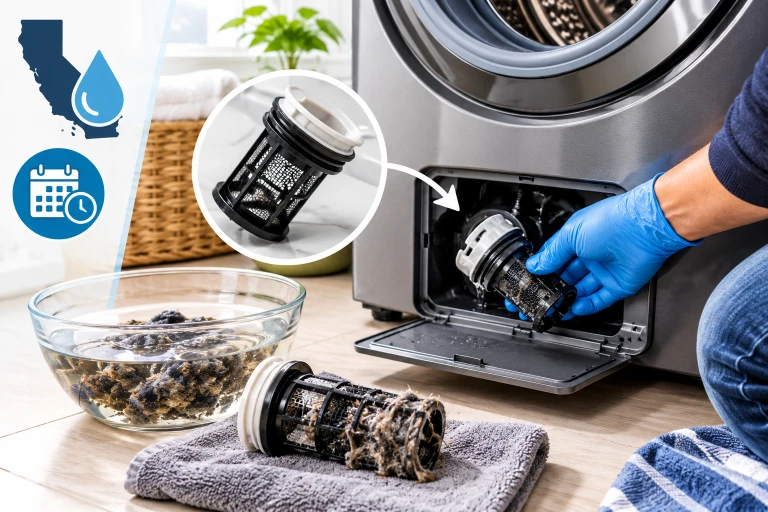
If your front-load washer is throwing an OE (LG), 5E (Samsung), E18 (Bosch), or F21 (Whirlpool) drain error, there is a good chance the solution is already on your property, costs nothing, and takes 10–15 minutes: cleaning the drain pump filter.
The drain pump filter — sometimes called the coin trap, debris filter, or pump access filter — sits at the bottom front of virtually every front-load washer sold since 2005. It’s designed to catch lint, coins, bobby pins, and small items before they reach the pump impeller. What it also catches, in California’s hard water, is mineral scale that accumulates on every wash cycle and progressively restricts water flow until the machine can no longer complete a drain cycle.
This guide covers exactly how to clean the filter on LG, Samsung, Bosch, and Whirlpool machines, how often to clean it based on your city’s water hardness, and what to do when cleaning the accessible filter doesn’t stop the drain error.
What the Drain Pump Filter Actually Does
Every front-load washer has a drain pump motor that forces water out through the drain hose at the end of each wash cycle. Before water reaches the pump impeller, it passes through a filter housing that collects debris. This filter is accessible from outside the machine — behind a small door at the lower front — and is designed to be cleaned by the homeowner.
In the engineering assumption embedded in most washer manuals, this filter should be cleaned “every few months” or “when the machine shows a drain error.” That assumption was written for water hardness conditions that bear no resemblance to Southern California’s 200–480 ppm reality. In California hard water, the filter doesn’t just collect lint and coins — it accumulates calcium carbonate mineral deposits that bond to the filter mesh and pump housing interior, often faster than manufacturer maintenance schedules anticipate.
Important distinction: The accessible filter you can clean yourself is only part of the drainage path. The pump housing — the cavity surrounding the impeller inside the machine — also accumulates internal scale that filter cleaning doesn’t reach. When a filter comes out clean but drain errors persist, the housing is the next investigation point. That requires professional service.
What You’ll Need Before You Start
- Shallow pan or baking tray (12″+ wide)
- Several old towels or rags
- Small soft-bristle brush (toothbrush or bottle brush)
- White vinegar or citric acid solution (for scale)
- Flashlight (to inspect the housing interior)
- Pliers with towel padding (if filter cap is stuck from scale)
Step-by-Step: How to Clean the Drain Pump Filter
Locate the Access Panel
On most front-load washers, the drain pump filter is behind a small rectangular door at the bottom front of the machine — usually lower-right corner. Some machines (certain Bosch models) have a panel that runs the full lower width and lifts off. Never seen this panel before? Check your model number on the manufacturer website for the exact access location. If you can’t find the door, look for a small indentation at the panel edges to press or pry gently.
Place Your Pan and Towels — You Will Get Water
This step is not optional. Even after the machine completes a drain cycle, 1–3 liters of water remain trapped in the pump housing. Place a wide, shallow tray directly under the access panel and lay towels around it. If your floor is hardwood or laminate, consider a waterproof mat first. A tray that’s too small or placed off-center will result in a wet floor.
Open the Drain Hose First (If Present)
Some machines have a small emergency drain hose clipped inside the access panel — a narrow corrugated tube with a cap. If yours has this (most common on Bosch, some Samsung, newer Whirlpool), pull it out and uncap it to drain the housing water into your pan before opening the main filter cap. This prevents a sudden flood. LG machines typically drain directly from the filter cap.
Slowly Unscrew the Filter Cap
The cap unscrews counterclockwise. Turn slowly — water flows as soon as the seal breaks. Keep the cap mostly closed while the initial rush drains into your pan. Once the flow slows, continue unscrewing and pull the filter out. If the cap is stuck — mineral deposits bonding the thread — grip it with a towel or use pliers with towel padding to avoid cracking the plastic.
Inspect and Clean the Filter
Rinse the filter under running water to remove lint and debris. For California homes with hard water, you’ll likely see white or grey mineral deposits on the mesh and body. Soak in undiluted white vinegar for 15–20 minutes or 10% citric acid solution for 10 minutes. Scrub gently with the soft brush. Rinse thoroughly. The filter should be visually clean — no grey crust, no scale on the mesh threads.
Inspect the Housing Cavity
With the filter removed, shine your flashlight into the housing cavity. Look for foreign objects near the impeller, and scale deposits on the housing interior walls. You should be able to rotate the impeller (the plastic propeller at the back) freely by hand. If it feels stiff or the housing walls show thick mineral deposits — this is the internal scale that causes recurring drain errors despite a clean filter. This requires professional pump housing descaling.
Reinstall and Test
Screw the filter cap clockwise until snug — not overtightened. Replace the emergency drain hose cap if applicable. Close the access panel. Run a Drain & Spin cycle and watch the panel area. No water at the panel = success. If the drain error code returns immediately, the housing or pump motor requires professional attention. Full drain error diagnosis guide here.
All front-load washers sold in the US after 2004 are required to have an accessible drain pump filter. If you can’t find it, the most common cause is a full-width lower panel (common on Bosch) that lifts straight off rather than swinging open. Search your model number plus “drain filter location” on YouTube — model-specific guides exist for virtually every LG, Samsung, Bosch, and Whirlpool front-loader sold in California. Note: top-load washers do not have this type of accessible filter — this guide applies only to front-load machines.
Clean the accessible filter first. Then run Drain & Spin and listen: if the machine attempts to drain (pump motor noise) but can’t drain fully — pump housing scale is restricting the impeller. If the machine is completely silent during the drain phase — no pump noise at all — the pump motor itself may have failed. If the drain error returns within 2–4 weeks after cleaning — the housing interior needs professional descaling. In California hard water at 220+ ppm, motor failure is far less common than scale restriction as the cause of drain errors.
How Often to Clean — By California City
| Region / City | Approx. Hardness | Recommended Filter Cleaning |
|---|---|---|
| Ventura city | ~479 ppm | Every 45–60 days |
| Thousand Oaks / Camarillo | ~350–400 ppm | Every 60–75 days |
| Simi Valley | ~350 ppm | Every 65–80 days |
| Encinitas / Mission Viejo / Laguna Niguel | ~278 ppm | Every 75–90 days |
| Poway / Escondido / Oceanside | 240–270 ppm | Every 80–90 days |
| Rancho Cucamonga / Fontana | 150–180 ppm | Every 90–120 days |
| Temecula / Murrieta | 150–200 ppm | Every 90–120 days |
| Elk Grove / Roseville / Sacramento | 50–100 ppm | Every 12–18 months (debris only) |
Brand-Specific Notes
LG Front-Loaders
Filter on LG WM3400, WM3900, WM4000, WashTower is in the lower-right corner behind a small flip-down door. Cap unscrews counterclockwise. Most LG models do not have an emergency drain hose — water drains directly when you open the cap. After cleaning, run Rinse & Spin. The OE error should clear if the filter was the cause. OE returning within 2–4 weeks in California hard water = pump housing needs professional descaling. See our LG repair page.
Samsung Front-Loaders
Samsung WF45, WF50, WF56 series typically have the filter behind a lower panel that swings open. Many Samsung models have the emergency drain hose clipped inside — always pull and drain this first. Samsung’s drain error codes are 5E and SE (same error, different display formats). After cleaning, run Drain & Spin. Samsung’s pump housing geometry can accumulate scale in ways that produce recurring 5E even after filter cleaning. Samsung repair details here.
Bosch 500 and 800 Series
Bosch front-loaders have a full-width lower panel that lifts off — press in at the center-bottom and pull. Filter cap is on the right side. Bosch machines typically have the emergency drain hose. E18 is Bosch’s drain error. Their pump housing has a slightly narrower internal geometry than LG or Samsung, which means scale restriction can become flow-critical faster at the same hardness level. In Ventura County or south OC cities, the 45–75 day filter cleaning schedule is especially important. Bosch service page here.
Whirlpool / Maytag Front-Loaders
Filter access varies by model year — lower-left or lower-right corner. The F21 error is Whirlpool’s long-drain code (drain taking more than 8 minutes — which scale restriction triggers). Newer models (2020+) have a simplified access panel. Same cleaning protocol as above.
Cleaned the filter and the error came back?
When a clean filter doesn’t stop drain errors, the pump housing interior has internal scale that DIY cleaning can’t reach. Professional housing descaling resolves it — $89 diagnostic credited to service.
When the Filter Isn’t the Problem
A clean filter that doesn’t resolve the drain error points to one of four things, in order of likelihood in California hard water:
- Internal pump housing scale — cavity behind the filter has mineral buildup restricting impeller rotation. Motor hum present but weak drainage. Professional descaling resolves this in 80–85% of cases where a clean filter didn’t help.
- Blocked drain hose — the corrugated hose connecting the pump to the wall drain can kink or accumulate debris. Confirm it’s not kinked and not inserted more than 6 inches into the standpipe.
- Pump motor failure — if completely silent during the drain phase (no motor hum), the motor may have failed. Confirmed motor failure requires replacement at $150–$325 depending on brand.
- Control board drain signal failure — rare; board stops sending the drain command. Usually accompanied by other unusual behaviors. Board testing is the last diagnostic step, not the first.
Frequently Asked Questions
Top-load washers (most Whirlpool, GE, Maytag, LG top-load models) do not have the same accessible front-panel filter that front-loaders have. Their drainage system is different. This guide applies specifically to front-load washers. If you have a top-load machine with drain problems, the most common causes are a clogged drain pump (requires professional access), a kinked drain hose, or a lid switch issue preventing the drain cycle from completing. Full drain troubleshooting guide here.
Don’t. Bleach does not dissolve calcium carbonate mineral scale — the primary contaminant in California hard water. It also degrades the rubber seal on the filter cap over time. For scale: white vinegar (5% acidity) or citric acid solution is correct and safe for all filter components. For mold or biofilm: mild dish soap solution is sufficient. Bleach should only be used in a machine’s drum cleaning cycle, not on filter plastic and rubber components.
A small amount of water pooling in the lower front of the door seal is normal on front-loaders — residual water by design. A significant amount of standing water in the drum after a completed cycle is not normal and indicates the drain cycle isn’t completing. Run a Drain & Spin only cycle after cleaning the filter. If that completes without error, the cleaning worked. If it throws a code, the pump housing or motor needs professional attention.
Leave a Comment
Questions about cleaning your drain pump filter?