
California Hard Water and Your Washing Machine: What’s Actually Happening Inside
Most California homeowners know their tap water is “hard” — but few understand what that actually means for the appliance running 6–10 loads of laundry every week. Here’s the real science, the real failure data, and what to do about it.
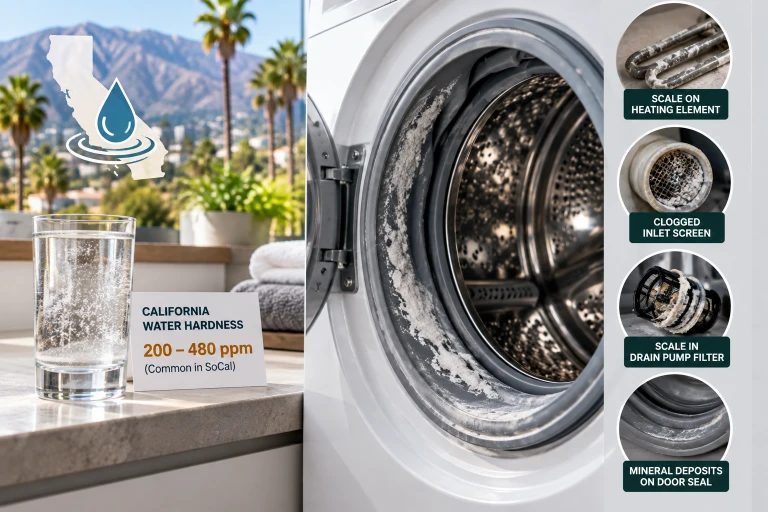
Southern California has some of the hardest tap water in the United States. Cities like Ventura (~479 ppm), Glendale (~360 ppm), Mission Viejo (~278 ppm), and Encinitas (~278 ppm) deliver water that carries dissolved mineral loads the USGS classifies as “very hard” — far beyond the 121 ppm threshold at which most appliance engineers begin expecting accelerated scale-related wear.
The washing machine sits at the intersection of two problems: it uses more water than almost any other household appliance, and it runs that water through rubber seals, mesh screens, pump impellers, and metal housings at high temperature and pressure. When that water is carrying 200–480 ppm of dissolved calcium and magnesium, those components don’t just wear out — they accumulate mineral deposits at a rate that shortens their functional lifespan measurably and predictably.
This guide covers what’s actually happening inside your machine, why California’s water makes the problem worse than most of the country, which components fail first and why, and how to set a maintenance schedule that reflects your city’s actual water hardness rather than the manufacturer’s generic guidance.
What “Hard Water” Actually Means — and Why California Has So Much of It
Water hardness is measured in milligrams per liter (mg/L) or parts per million (ppm) of dissolved calcium carbonate. The USGS classification breaks down as:
| Category | Hardness (ppm) | Description |
|---|---|---|
| Soft | 0–60 ppm | Minimal mineral content; common in Sacramento Valley and Pacific Northwest |
| Moderately Hard | 61–120 ppm | Slight scaling over long periods |
| Hard | 121–180 ppm | Noticeable scaling; appliance maintenance intervals begin to matter |
| Very Hard | 180+ ppm | Significant scale accumulation; manufacturer schedules become inadequate |
Sacramento, fed by Sierra Nevada snowmelt through the American and Sacramento rivers, sits comfortably in the soft range at 50–100 ppm. Southern California is a different story. The Colorado River — the primary source for the Metropolitan Water District of Southern California, the San Diego County Water Authority, and dozens of regional agencies — has traveled hundreds of miles through calcium-rich desert geology before reaching a treatment plant. Even after treatment, it delivers 200–350+ ppm to taps throughout the region.
In cities where local groundwater supplements the Colorado River import, hardness can reach extremes. Ventura’s municipal water tests at approximately 479 ppm — nearly four times the USGS “hard” threshold and among the highest of any California city.
Conventional municipal treatment — coagulation, filtration, chlorination — removes bacteria and sediment but not calcium and magnesium hardness. Water softening at municipal scale would require ion exchange infrastructure no California utility currently operates. Hardness passes through treatment plants intact. Removing it at home requires a point-of-entry water softener.
No — parts of Arizona, Nevada, and New Mexico have comparable or worse hardness. But among major metros, Southern California is consistently near the top. The USGS national hardness map shows the Colorado River basin — which feeds Southern California — as among the hardest source waters in the continental US. Sacramento Valley’s water is genuinely soft, making California one of the few states with a dramatic intrastate hardness contrast.
What Hard Water Does Inside Your Washing Machine
When hard water heats up — as it does in the wash cycle — dissolved calcium and magnesium precipitate out of solution and bond to whatever surface they contact first. In a washing machine, five key components experience mineral accumulation at a rate proportional to water hardness.
1. Drain Pump Filter and Housing
The drain pump filter (accessed through the lower front panel on most front-loaders) collects lint, debris, and mineral deposits each wash cycle. At 200–280 ppm, a filter cleaned annually develops enough scale to begin restricting drainage within 90–120 days. At 350–479 ppm (Ventura County range), that timeline compresses to 45–75 days. The filter you can access and clean is only part of the drainage path — the pump housing itself accumulates internal scale around the impeller that DIY filter cleaning doesn’t reach.
These scale-driven restrictions are frequently misdiagnosed as pump motor failure — one of the most expensive misdiagnoses in California’s appliance repair market. The motor almost never fails first. The housing does. See our drain error diagnosis guide for the full diagnostic sequence.
2. Inlet Valve Mesh Screens
The inlet valve at the rear of the machine has small stainless mesh screens designed to catch sediment. In California hard water at 200–280 ppm, they calcify on a 12–18 month cycle. At 350+ ppm, 8–12 months. When fully calcified, they restrict water flow enough to trigger fill errors (LG IE, Samsung 4E) before the solenoid itself fails.
Cost impact of inlet screen misdiagnosis: A calcified inlet screen causes the same fill error as a failed solenoid coil. Testing the solenoid before descaling the screen adds an unnecessary $90–$130 to the repair. In California’s hardness range, fill errors are calcified screens until proven otherwise — not failed solenoids.
3. Door Boot Seal (Front-Loaders)
The door boot seal is constantly exposed to the chemistry of every wash cycle. In hard water, dissolved minerals embed into the rubber, causing it to stiffen and lose elasticity. A seal that stiffens and cracks allows water to reach the drum bearing housing. Drum bearings are not designed to tolerate water exposure — when water reaches them, they corrode and fail within 3–6 months. This converts a $155–$310 door seal repair into a $240–$450 drum bearing repair. In California’s hardest water cities, door boot seals on unserviced machines often fail at 3–6 years rather than the 8–12 year lifespan expected in soft-water markets.
4. Drum Bearings (Downstream of Seal)
Drum bearing failure — roaring or grinding noise that intensifies with spin speed — is almost always downstream of a failed door seal in California’s hard water markets. The bearing itself is not scale-damaged; it’s water-damaged after the seal’s mineral degradation allowed water ingress. This is why bearing failures in OC, San Diego, and Ventura County appear earlier than in Sacramento. More on bearing diagnosis here.
5. Heating Elements (Bosch, Miele, Some Electrolux)
Machines with internal heating elements accumulate limescale directly on the element surface. Limescale is a thermal insulator — as it builds up, the element works harder to reach target temperature, drawing more current and shortening its lifespan. This is a significant maintenance consideration for premium European brands common in LA, OC, and San Diego premium markets.
California Hardness by City — What Your Washer Is Actually Dealing With
| City | Water Source | Hardness (ppm) | Recommended Filter Cleaning |
|---|---|---|---|
| Ventura | City groundwater | ~479 ppm | Every 45–60 days |
| Thousand Oaks | Calleguas MWD (Colorado River) | ~350–400 ppm | Every 60–75 days |
| Simi Valley | SVMWD (local + MWD import) | ~350 ppm | Every 65–80 days |
| Encinitas | SMWD (Colorado River) | ~278 ppm | Every 60–90 days |
| Mission Viejo | SMWD (Colorado River) | ~278 ppm | Every 60–90 days |
| Poway | SDCWA (Colorado River + SWP) | 240–270 ppm | Every 75–90 days |
| Rancho Cucamonga | Chino Basin + MWD | ~150–180 ppm | Every 90–120 days |
| Sacramento / Elk Grove | SCWA (Sierra Nevada surface) | 50–80 ppm | Every 12–18 months (debris only) |
Sources: 2024 municipal Consumer Confidence Reports; SDCWA, MWDOC, Calleguas MWD, SMWD, SCWA water quality data.
Yes, measurably. Hard water minerals react with surfactants in laundry detergent and reduce cleaning efficiency. Calcium and magnesium ions bind to soap molecules before they bind to dirt, producing soap scum that deposits on fabrics. This is why California residents often notice clothes feel less clean at standard detergent doses — and why detergent manufacturers recommend more product in hard water. Liquid detergents and HE pods perform better than powder in hard water.
Yes — a point-of-entry ion exchange softener reduces hardness to near zero and effectively eliminates scale-related failure modes entirely. In Ventura, Thousand Oaks, and south OC at 300+ ppm, the math on a softener ($1,000–$3,000 installed) becomes compelling: extended appliance lifespan, reduced descaling maintenance, lower detergent consumption, and protection for dishwashers and water heaters simultaneously. At 300+ ppm it typically pays for itself within 5–8 years.
The Maintenance Protocol That Matches Your City’s Water
Manufacturer maintenance schedules are written for the median US consumer, whose tap water averages roughly 110–130 ppm nationally. Here is a protocol calibrated to actual California hardness levels:
Drain Pump Filter Cleaning (Front-Loaders)
Access via the lower front panel. Unscrew the filter cap slowly into a shallow pan. Remove, rinse, descale with white vinegar or citric acid solution, brush clean. At 200–280 ppm: every 75–90 days. At 280–400 ppm: every 60–75 days. At 400+ ppm: every 45–60 days. Our full filter cleaning step-by-step guide covers every major brand.
Inlet Valve Screen Descaling
Turn off water supply. Disconnect supply hoses from the back of the machine. Remove mesh screens from each inlet port with needle-nose pliers. Soak in white vinegar 20 minutes or 10% citric acid solution 15 minutes. Rinse and reinstall. Annual at 150–280 ppm; every 8–10 months at 300+ ppm.
Door Boot Seal Inspection (Front-Loaders)
Wipe seal folds dry after every wash. Monthly, pull back the inner fold of the lower seal and inspect for early cracking, stiffening, or dark discoloration. At 220–280 ppm: inspect every 5–6 months. At 300+ ppm: inspect every 4 months. First sign of cracking — schedule professional replacement. A $155–$310 repair becomes $250–$450 if deferred until water reaches bearings.
Monthly Descale Cycle
Run an empty hot-water cycle with 2 cups of white vinegar or one citric acid descaling tablet monthly. This dissolves light scale deposits before they accumulate permanently. For Ventura city at 479 ppm, bi-weekly is appropriate. Never combine vinegar and descaling tablet in the same cycle.
Dispenser Drawer Cleaning
Remove the detergent dispenser drawer entirely. Soak monthly in warm water with citric acid or white vinegar. Scale accumulates in drawer compartments and restricts detergent dispense — a common overlooked cause of clothes not cleaning properly in California hard water.
Has your washer started throwing drain or fill errors?
In California hard water, most drain errors (OE, 5E, E18, F21) and fill errors (IE, 4E) are scale-related — not component failure. A $89 diagnostic determines whether it’s scale restriction or actual mechanical failure before any parts are quoted.
The Financial Case for Hard Water Maintenance in California
Prevention math in California’s hard-water cities is straightforward. At Ventura County hardness levels (350–479 ppm), a front-loader without proper maintenance can expect:
- Pump housing descaling at year 1–2: $89–$190
- Inlet valve replacement from progressive screen calcification by year 2–3: $175–$280
- Door boot seal replacement at year 4–5: $155–$310
- Drum bearing replacement from seal-transmitted water damage by year 5–7: $240–$450
- Total unplanned repair cost: $659–$1,230 over 7 years
A maintained machine on correct intervals for 350–479 ppm water can expect:
- DIY filter cleaning quarterly (15 min each): $0
- Monthly descale cycles (vinegar or tablet): $15–$25/year
- Professional pump housing descale once every 2–3 years: $89–$190
- Inlet screen descale annually (DIY): $2–$5 in citric acid
- Door seal replacement at 6–8 years (instead of 3–5): $155–$310
- Total maintenance cost: $350–$600 over 7 years
The difference isn’t just dollars — it’s the number of times you have an unexpected appliance failure mid-week with laundry waiting. Maintaining on the right schedule for your city’s water hardness eliminates most of those calls entirely. See also: California washer repair cost guide and repair vs. replace framework.
Frequently Asked Questions
Your water utility publishes an annual Consumer Confidence Report (CCR) by July 1 each year. Search “[your city] water quality report 2024” or “[your water district] CCR” to find it. It includes hardness data (often listed as calcium carbonate mg/L or GPG). Alternatively, test strips ($8–$15 for 50 strips) from any hardware store give an immediate ppm reading accurate to within ±10%.
Concentrated citric acid or vinegar used too frequently can degrade rubber seals. The safe protocol is a monthly empty hot cycle with 2 cups of white vinegar (5% acidity) OR a commercial citric acid descaling tablet — not both together. Do not use full-strength citric acid above 15% on rubber seals directly. For screens and filter: 10% citric acid solution for 15–20 minutes is safe. Never combine bleach and vinegar in the same or consecutive cycles.
Yes, especially so. Scale accumulation begins on the first wash cycle — it doesn’t wait until the machine is old. A new LG front-loader in Mission Viejo at 278 ppm will have a measurably calcified pump filter within 90 days of regular use and calcified inlet screens within 18 months if no maintenance is performed. Establishing correct maintenance habits early is the difference between a machine that lasts 10–12 years and one that begins generating service calls at year 5.
Partially, but not enough to change your maintenance schedule. Mineral precipitation is accelerated by heat — a 140°F wash cycle deposits scale significantly faster than a cold-water cycle. However, even at cold temperatures, California hard water still deposits minerals on pump filters, inlet screens, and door seals during each cycle — just more slowly. Cold-water washing can extend filter cleaning intervals by perhaps 20–30% in moderate hardness areas, but in cities above 280 ppm the maintenance schedule remains compressed regardless of wash temperature.