
Whirlpool & Maytag Washer Error Codes — Complete California Guide
F21 won’t drain. F9E1 drain timeout. F5E2 door lock. F8E1 won’t fill. This guide covers every common Whirlpool and Maytag error code — what each one means, the first thing to check, and the California hard water context that changes the diagnosis in most Southern California homes.
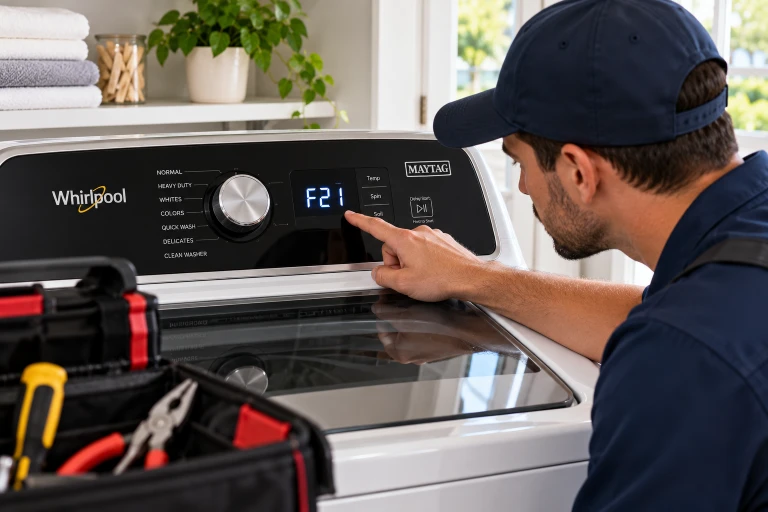
Whirlpool and Maytag are the same washing machine. Maytag was acquired by Whirlpool Corporation in 2006, and most Maytag washers sold since then share the same mechanical platform, control system, and error code language as their Whirlpool counterparts. Understanding this matters for diagnostics: the same error code on a Maytag Bravos and a Whirlpool Cabrio is the same fault — same cause, same fix, same California hard water context.
These two brands represent the largest combined installed base of any washer manufacturer in California. If you own a Whirlpool or Maytag and your machine just displayed a code you’ve never seen before, this guide gives you the diagnosis and first steps — in plain language, without requiring you to navigate a 90-page service manual.
California context: Many Whirlpool and Maytag error codes — particularly F21, F9E1, F8E1, and F01 — present differently in California depending on your city’s water hardness. In Southern California cities above 250 ppm (Ventura at 479 ppm, Burbank at 315 ppm, Pasadena at 276 ppm), drain and fill errors are frequently scale-driven, not mechanical. In Bay Area and Sacramento soft-water cities, the same code almost always means debris or a component fault. This guide identifies the California-specific interpretation for each relevant code.
How Whirlpool and Maytag Display Error Codes
Whirlpool and Maytag use two different error code formats depending on model generation:
- Older format (pre-2015 Duet, older Bravos/Cabrio): Single letter + two-digit number — F21, F01, F28, F35. These appear on front-load and some top-load models from the mid-2000s through mid-2010s.
- Newer format (2015+ Intuitive and HE models): Letter + letter + digit — F9E1, F5E2, F8E1, F3E1. The F identifies the system (F8 = fill, F9 = drain, F5 = lid/door) and the E-number identifies the specific fault within that system.
If your machine shows F21 and F9E1: these are the same error. F21 is the older display format; F9E1 is how the same drain-timeout fault appears on newer models. Same diagnosis, same fix.
To retrieve stored fault codes manually: unplug the machine, wait 30 seconds, plug back in, then on most models open and close the lid 6 times within 12 seconds. Check your specific model’s service sheet (often inside the control panel lid or cabinet) for the exact sequence.
F21 / F9E1 — Long Drain Error (Most Common)
This is the single most common Whirlpool and Maytag service call in California. The error triggers when the machine cannot drain to the expected water level within the allowed time — approximately 8 minutes on most models.
What it means
The drain cycle started but took too long — water is still above the sensor threshold when the timer expires. This is not necessarily a pump motor failure. In the majority of California cases, the pump motor is still functional; something is restricting flow.
Causes in order of likelihood (California context)
- Clogged drain pump filter — the most common cause overall. In hard water cities like Ventura, Burbank, and Pasadena, mineral scale bonds to lint and debris in the filter housing, creating a restriction that gradually worsens. In soft water Bay Area and Sacramento cities, the filter collects lint and foreign objects. Check this first — it costs nothing and takes 10 minutes.
- Kinked or blocked drain hose — the corrugated hose behind the machine can kink against the wall or accumulate debris where it enters the standpipe.
- Drain hose too high — if the drain hose exceeds 96 inches (8 feet) from the floor to the standpipe entry, the machine cannot overcome back pressure. This is a common installation error in California townhomes with elevated laundry areas.
- Over-sudsing — excess suds from too much HE detergent (or non-HE detergent in an HE machine) create foam that the drain pump cannot handle efficiently. The F21 appears mid-cycle rather than at the end. Very common in soft-water Bay Area homes where standard detergent doses produce far more suds than in hard water.
- Failed drain pump motor — if the machine is completely silent during the drain phase (no pump hum), the motor has failed. Much less common than the above four causes.
First steps before calling a technician
Clean the drain pump filter
On Whirlpool and Maytag front-loaders, the filter is behind the small access door at the lower front of the machine. Place towels and a shallow pan below, open the door, slowly unscrew the filter cap counterclockwise, let water drain, remove debris and scale. Rinse filter under running water. Reinstall and run Drain & Spin. See our complete filter cleaning guide for the step-by-step process.
Check the drain hose
Pull the machine slightly from the wall. Check the hose for kinks at the connection point and along the run. Confirm the hose enters the standpipe no more than 6 inches — overly deep insertion creates a siphon effect. Confirm total hose height does not exceed 96 inches from the floor.
Run a Drain & Spin only cycle
After cleaning the filter and checking the hose, run a Drain & Spin cycle with no load. Listen for the pump motor engaging (a distinct hum or whirring sound). If the cycle completes without F21/F9E1, the cleaning resolved it. If the code returns immediately, the pump housing has internal scale that filter cleaning doesn’t reach, or the pump motor has failed.
F8E1 / LF / Lo FL — Long Fill Error (Won’t Fill)
The machine cannot reach the target water level within the allowed fill time (typically 8–10 minutes). The control stops the cycle and displays F8E1 (newer models) or LF/Lo FL (some display variants).
California hard water context
In California cities above 200 ppm, the inlet valve mesh screens — two small screens at the back of the machine where the water supply hoses connect — accumulate mineral scale over time. This is the most common cause of F8E1 in SoCal hard water areas. The screens partially clog, restricting flow below the rate the machine expects, and the fill timer expires before the drum reaches the target level.
Cleaning the inlet screens is a free fix that takes 15 minutes and resolves F8E1 in a significant proportion of California cases. Check the water supply valves are fully open first (turned counterclockwise to the stop), then turn off the water, disconnect the supply hoses from the back of the machine, and inspect the small screens inside the hose inlet ports. Clean with a soft brush or toothpick if scale or debris is visible.
Other causes
- Supply valves not fully open — the single most easily overlooked cause. Both hot and cold shutoff valves behind the machine must be turned fully counterclockwise.
- Kinked supply hose — inspect both inlet hoses at the back panel connection and at the wall valve.
- Failed water inlet valve solenoid — if screens are clean and supply is confirmed good, the valve itself may have failed. Replacement cost $95–$190 including labor.
- Pressure switch or control board fault — the pressure switch measures water level and reports to the control board. If it’s stuck in a “full” position, the board never opens the inlet valve. Less common than the above causes.
F5E2 / F5E3 — Door Lock Error
The door lock assembly cannot confirm the door is latched. On front-loaders, this prevents the cycle from starting or causes a mid-cycle stop. On top-loaders, an equivalent lid lock fault does the same.
What to check first
Confirm the door is fully closed and the latch mechanism is not obstructed — a small piece of clothing caught at the door edge is the most common cause of F5E2 on front-load models. Open the door, inspect the latch strike and the door seal for obstructions. Close firmly and restart.
If the door closes correctly and the error persists: the door lock assembly has an internal fault. This is one of the most commonly misdiagnosed errors — door lock failure is frequently attributed to the control board by technicians who don’t test the lock assembly first. A functioning door lock assembly is required for the control board to even receive a cycle-start signal, so door lock failure can appear to be a total non-responsive machine. The door lock is typically a $120–$220 repair including labor — significantly less than a board replacement.
F7E1 — Motor / Drive System Fault
The control board cannot detect a valid speed signal from the motor. The washer stops — usually mid-spin or at the transition from wash to spin — and displays F7E1.
First step: unplug the machine for 5 minutes (not 30 seconds — a full 5 minutes allows capacitors to discharge and the control to fully reset). Plug back in and run a short cycle. A software glitch or brief power surge can trigger F7E1 without any mechanical fault, and a proper reset resolves it in a meaningful proportion of cases.
If F7E1 returns after reset: the motor tachometer, motor control board (MCU), or motor itself has a fault. This is not a DIY repair — motor system diagnosis requires specialized tools. The capacitor on the motor (which helps start the motor under load) is a common single point of failure that produces F7E1 symptoms and is a less expensive repair than a full motor replacement. A technician who starts with the capacitor rather than immediately recommending a motor is giving you the correct diagnostic priority.
SUD / 5D — Excess Suds Detected
The machine detects foam levels that would interfere with the drain and spin. The cycle pauses automatically — this is not a malfunction. The machine is protecting itself from the consequences of over-sudsing: pump motor strain, incomplete drainage, and door seal fouling.
Bay Area water is soft (San Francisco SFPUC runs 30–80 ppm). Soft water activates detergent surfactants far more efficiently than hard water — the same dose creates dramatically more suds. Standard HE detergent measurements are calibrated for national-average water at ~120 ppm. At 40 ppm, you need 20–30% less detergent than the label says to avoid SUD errors. Your parents’ LA hard water suppresses sudsing, so the same dose works fine there.
No. Non-HE detergents produce dramatically more suds than HE formulations. In a high-efficiency machine that uses 12–15 gallons of water per cycle (vs. 40+ gallons in older top-loaders), non-HE suds overwhelm the drain system. SUD errors, incomplete drainage, door seal mold, and pump motor stress all result. Switch to any HE-labeled detergent and reduce the dose to the lower fill line — or to the soft-water adjustment if you’re in a Bay Area or Sacramento zip code.
Complete Error Code Reference Table
| Error Code | What It Means | First Check | CA Hard Water Factor |
|---|---|---|---|
| F21 / F9E1 | Long drain — took more than 8 minutes | Clean drain pump filter | High — scale is often the cause above 250 ppm |
| F8E1 / LF / Lo FL | Long fill — cannot reach water level in time | Check supply valves fully open; inspect inlet screens | High — inlet screens scale up in hard water cities |
| F5E2 / F5E3 | Door / lid lock fault | Check for obstruction; confirm door closes firmly | Low — mechanical fault, not water-related |
| F7E1 | Motor / tachometer signal fault | Full 5-minute power reset | Low — mechanical/electrical fault |
| SUD / 5D | Excess suds detected — cycle paused | Reduce detergent dose; switch to HE detergent | High — soft water cities over-sud at standard doses |
| F1E1 | Control board (CCU) fault | Power reset; if persistent, board test required | Low — rule out all other causes first |
| F3E1 / F3E2 | Pressure switch / water level sensor fault | Professional diagnosis — sensor or wiring test | Low — sensor fault, not scale-driven |
| F0E5 / UE | Unbalanced load during spin | Open, redistribute clothes evenly, restart spin | None — load distribution issue |
| F6E1 | Communication error — main board to motor board | Power reset; check wiring harness connections | Low — electrical fault |
| LOC / LC | Control lock / child lock active | Hold the Control Lock button for 3 seconds | None — user setting |
Error code returning after your own checks?
If F21 comes back after filter cleaning, or F8E1 persists with good water supply, a technician needs to check the pump housing or inlet valve — these require professional access and equipment.
Frequently Asked Questions
Yes. Whirlpool Corporation owns Maytag, and its service network and parts supply covers both brands. A technician who services Whirlpool machines services Maytag machines — the platforms are shared. Parts availability is generally good for both brands across California, including Central Valley and desert areas that can be underserved for some other brands.
A power reset can clear a code caused by a temporary glitch — particularly for F7E1 (motor) and F1E1 (board) codes that sometimes appear after power surges. The proper reset is a full 5-minute unplug, not 30 seconds. However, if the underlying fault (blocked drain, failed door lock, restricted inlet valve) hasn’t been resolved, the code will return on the next cycle. A code that returns immediately after a reset indicates a real component fault, not a software glitch.
Most Whirlpool and Maytag top-load washers do not have the same user-accessible front-panel drain filter that front-loaders have. Top-load drain issues are typically caused by a kinked or blocked drain hose, a foreign object in the pump (requires technician access), or motor coupling failure on older direct-drive top-loaders. If your top-loader is showing F21 or F9E1, check the drain hose first, then call for professional service — DIY pump access on top-loaders typically requires removing the cabinet.
In California hard water cities above 200 ppm, a filter that clears and re-clogs within weeks almost always means the pump housing interior has accumulated scale that filter cleaning doesn’t reach. The housing cavity behind the filter surrounds the impeller, and mineral scale on the housing walls restricts impeller clearance progressively. Filter cleaning removes the accessible blockage, but the housing restriction remains and the filter re-clogs faster against the reduced flow. Professional pump housing descaling is the correct resolution — not repeated filter cleaning.
Leave a Comment
Questions about Whirlpool or Maytag error codes?